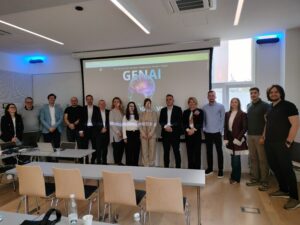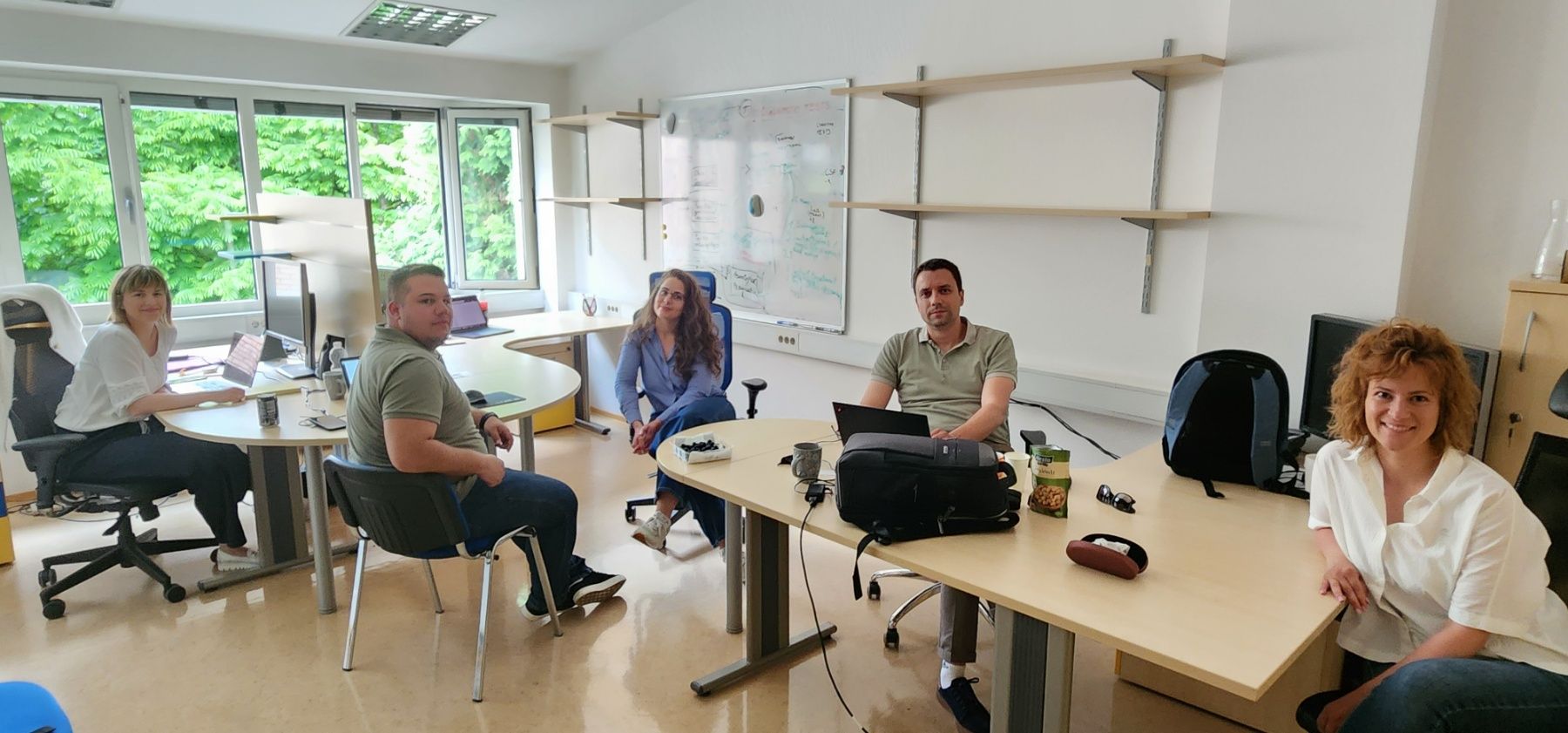
A cornerstone of the ChatMED project is the exchange of expertise between widening countries and leading international research centers. In May 2025, five key staff members from the consortium spent three intensive weeks at the Jožef Stefan Institute (JSI) in Ljubljana, Slovenia.
These Short-Term Staff Exchanges (STSEs) focused on four specific topics, each resulting in tangible assets for the project.
Topic 1: The AI Neurologist Assistant
- Focus: Developing a real-cases based methodology for a decision making in Neurology.
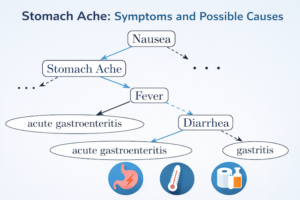
- Outcome: Led by Profs. Kostadin Mishev and Katarina Trojachanec Dineva, junior researchers Ana Todorovska and Dimitar Kitanovski collaborated with Prof. Stevo Lukic (FMN) to design a new methodology. Leveraging clinical cases from handbooks and journals, they mapped the physician’s reasoning process into a structured workflow, spanning patient history, physical exams, and diagnostic recommendations. The methodology will be refined in the upcoming period and is expected to be published in an Open Access journal in early 2026.
Topic 2: Vision-Enabled AI for Imaging
- Focus: Integrating advanced neuroimaging (MRI, CT, PET) into the ChatMED system.
- Outcome: Prof. Katarina Trojachanec Dineva worked on Vision-Enabled Large Language Models (MLLMs). She designed an approach for testing the performance of multiple MLLMs on various datasets with the aim of eventually creating a multi-agent neuroimaging system as part of the ChatMED platform.
Topic 3: Retrieval-Augmented Generation (RAG)
- Focus: Improving the accuracy of medical AI responses.
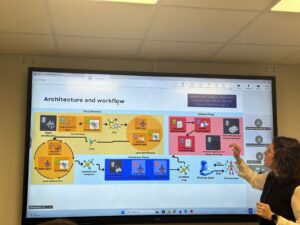
- Outcome: Prof. Kostadin Mishev together with ass. Jovana Dobreva prototyped three different RAG pipelines: VectorRAG, GraphRAG, and HybridRAG. To test which one works best, they created RAGCare-QA, a benchmark dataset of 420 medical questions. This work ensures that when a doctor asks the AI a question, the answer is grounded in verified medical literature rather than statistical guesses.
Topic 4: Compliance and Ethics by Design
- Focus: Ensuring medical software meets strict EU regulations.
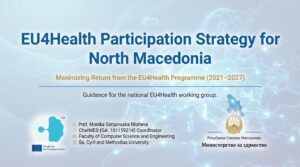
- Outcome: Originally scheduled for Year 2, this exchange was accelerated to Year 1. Prof. Monika Simjanoska Misheva developed a comprehensive compliance tutorial. This “blueprint” enables the mapping of the ChatMED software lifecycle directly to the EU AI Act and MyHealth@EU standards, ensuring that high-risk AI components are safe, transparent, and legally compliant from day one.
These exchanges successfully transformed theoretical goals into working prototypes, datasets, and compliance frameworks that will define the future of the ChatMED platform.