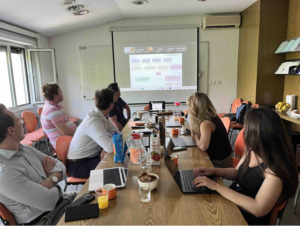
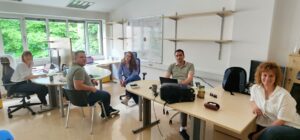
The first ChatMED Summer School was originally envisioned as a simple networking event. However, driven by the consortium’s momentum, it evolved into something much more ambitious: proposals co-creation laboratory.
Held under the title “Interdisciplinary Innovations,” the week-long event gathered experts from AI, neurology, clinical practice, and software quality to co-develop a competitive proposal for the EIC Pathfinder Challenge.
The Challenge: Revolutionizing Cancer Diagnosis with GenAI
The team focused their collective expertise on a single, high-impact goal: creating “Generative-AI Based Agents to Revolutionize Medical Diagnosis and Treatment of Cancer”. The diverse group included participants from FCSE, JSI, the neurology team at FMN, software quality experts from TU Graz, and clinical partners from the Zan Mitrev Clinic in Skopje (ZMC) – a newcomer in the ChatMED network.
The agenda was structured to tackle specific demands of the call day by day, unrolling comprehensive discussions about:
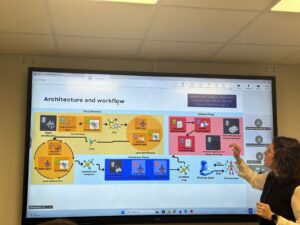
- Multimodal Fusion: The team designed an architecture that fuses spatial data (images) with temporal data (patient history) to create a complete view of the patient.
- Data Augmentation: Recognizing the scarcity of medical data for rare tumors, they defined a pipeline for generating high-quality synthetic data to train the models.
- Knowledge Representation: To ensure standardized vocabularies, the group reached a consensus that robust data modeling is a prerequisite for high-quality AI outcomes.
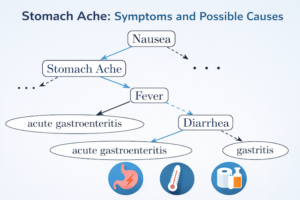
- Predictive Diagnosis: A “front-door triage agent” was mapped out to assist with early detection, using decision trees to validate the AI’s therapy recommendations.
- Trustworthy AI: The ChatMED’s rigorous evaluation framework combining technical benchmarks with real-world clinical user studies was proposed to be applied for ensuring the system is robust and explainable.
The Outcome - By the end of the week, the summer school had produced far more than just new contacts. It delivered a multi-agent GenAI architecture, a synthetic data pipeline, and a strategic partnership with clinical providers.
- The daily brainstorming notes and architectural designs are now forming the backbone not only of the EIC Pathfinder Challenge proposal to be submitted in October 2025, but also of a Horizon Health Cluster call with a submission deadline in September 2025.
This event proved that when computer scientists, neurologists, and clinicians collaborate intensively, they can accelerate the path from research to life-saving innovation.