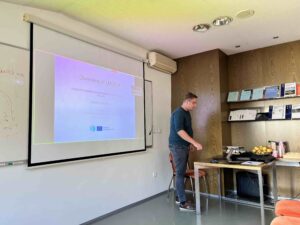
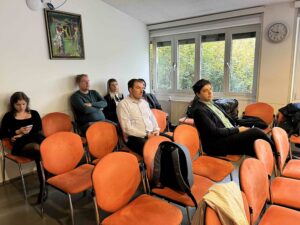
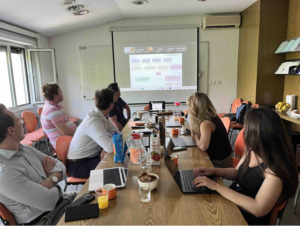
On October 7, 2025, the ChatMED consortium convened at the Jožef Stefan Institute in Ljubljana for a vital training session held during the 28th Information Society Multiconference. Targeted specifically at technical and administrative staff as well as senior researchers, this session was designed to fortify the essential skills required to navigate the complexities of EU-funded research.
The workshop provided a comprehensive toolkit for interdisciplinary project management, financial control, quality assurance, and software engineering. Here are the key highlights from this capacity-building event.
1. Management Essentials: Roles, Risks, and Lifecycles
The session began by addressing the specific challenges of interdisciplinary projects, which often struggle due to vague roles and weak coordination. To counter this, the training introduced “minimum viable structures” to streamline collaboration.
Clarifying Roles with RACI: To ensure accountability, the team applied the RACI model (Responsible, Accountable, Consulted, Informed). A critical rule emphasized was that while multiple people can be “Responsible” for doing the work, there must be only one “Accountable” person who owns the final decision.
The Project Lifecycle: Participants navigated the standard lifecycle: Initiation (confirming success criteria), Planning (creating executable schedules), Execution (building with discipline), Monitoring (ensuring no surprises), and Closure (handover and archiving).
Proactive Risk Management: The group focused on identifying top risks early, such as GDPR issues or staff turnover, and defining clear mitigation triggers (e.g., “if X happens by date Y, do Z”).
2. Quality Assurance: Traceability and Gates
Quality Assurance (QA) was presented not as a bureaucratic hurdle, but as a mechanism for trust and reproducibility.
Quality Gates: The concept of “Quality Gates” was introduced to check deliverables before external submission. These gates verify completeness, evidence (data/test results), and compliance with IP and security standards.
Definition of Ready & Done: To prevent rework, tasks must meet a Definition of Ready (DoR) (objectives and inputs confirmed) before starting, and a Definition of Done (DoD) (peer reviewed, tests passed, metadata complete) before release.
Traceability: A template was provided to create a Traceability Matrix, ensuring every requirement links to a specific task, validation test, and final deliverable.
3. Financial and Project Control with EMDESK
For financial and resource management, the team received an overview of EMDESK, a platform tailored for Horizon Europe projects.
Integrated Management: EMDESK was highlighted for its ability to centralize project planning, budgeting, and resource allocation in one secure, cloud-based platform.
Real-Time Monitoring: The tool provides dashboards that visualize budget consumption by partner and Work Package, offering real-time transparency on financial progress and deviations.
Efficiency: While aimed at complex consortia, the platform ultimately reduces administrative workload by accelerating reporting and proposal writing.
4. Software Engineering Best Practices
To ensure technical excellence, the session concluded with a deep dive into software best practices, focusing on version control, documentation, and code quality.
Git Fundamentals: The training covered distributed version control using Git, emphasizing branching strategies where new features are developed on separate branches and merged into the master branch only after completion.
Automated Documentation: Developers were introduced to Sphinx, the standard tool for generating Python documentation. By using ReStructuredText (RST), the team can create professional documentation directly from the codebase.
Coding Standards (PEP 8): To maintain clean and consistent code, strict adherence to PEP 8 was mandated, including rules such as using 4 spaces for indentation and descriptive variable names.
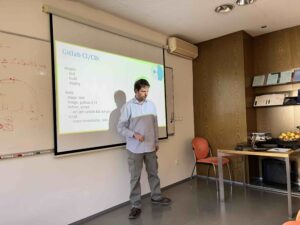
CI/CD Pipelines: The session demonstrated GitLab CI/CD for automation, showing how to define stages like test, build, and deploy to ensure code quality and seamless deployment.
This targeted training session at IS2025 successfully reinforced the consortium’s core capabilities. By strengthening administrative skills through rigorous project management and financial tools, and enhancing technical proficiency through standardized software practices, the ChatMED team is better equipped to execute its mission with precision and efficiency.
The slides from the training session can be found into the knowledge repository.