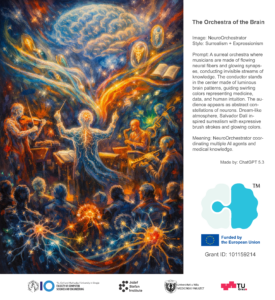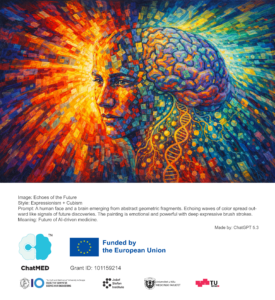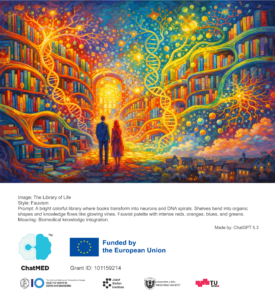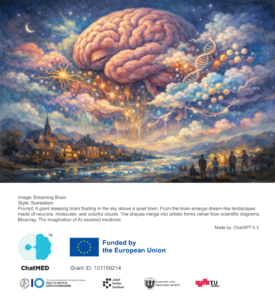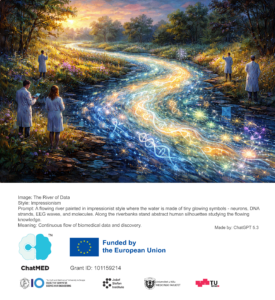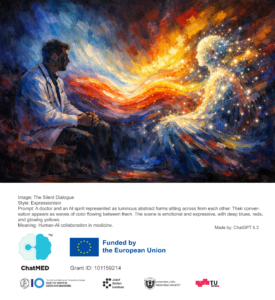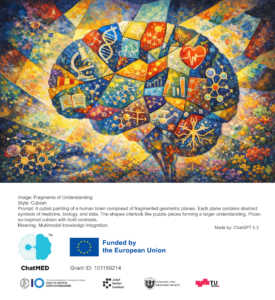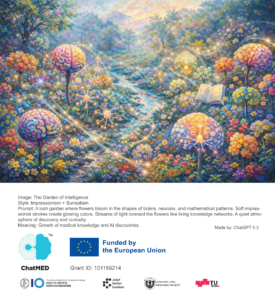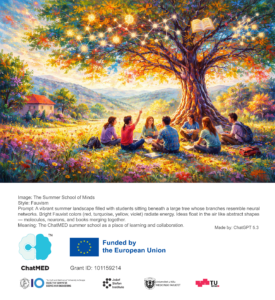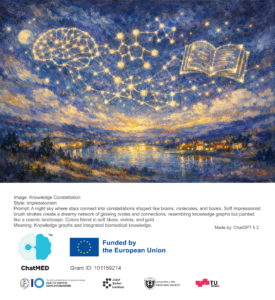
In a summer school dedicated to understanding the mind, art became another language for exploring it. Alongside lectures, workshops, and discussions, the School of Minds introduced another dimension: reflection.
The artworks were not illustrations of technology. They were visual provocations, inviting visitors to think about intelligence, memory, cognition, identity, and the increasingly blurred boundary between biological and artificial systems.
Visualizing the Invisible
One of the recurring challenges in neuroscience and AI is that many of the most important concepts are invisible.
We cannot directly see memory formation, reasoning processes, neural plasticity, or machine cognition. We describe them through models, diagrams, mathematical equations, and datasets.
Art offered a different approach.
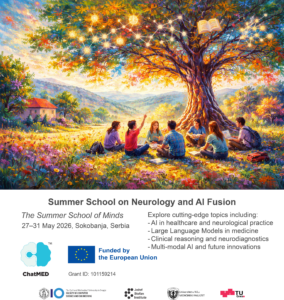
Inspired by themes emerging from the ChatMED project, the exhibition transformed complex scientific ideas into visual experiences. Through abstract structures, neural-inspired forms, and futuristic visual narratives, the artworks provided alternative interpretations of concepts that are often confined to scientific vocabulary.
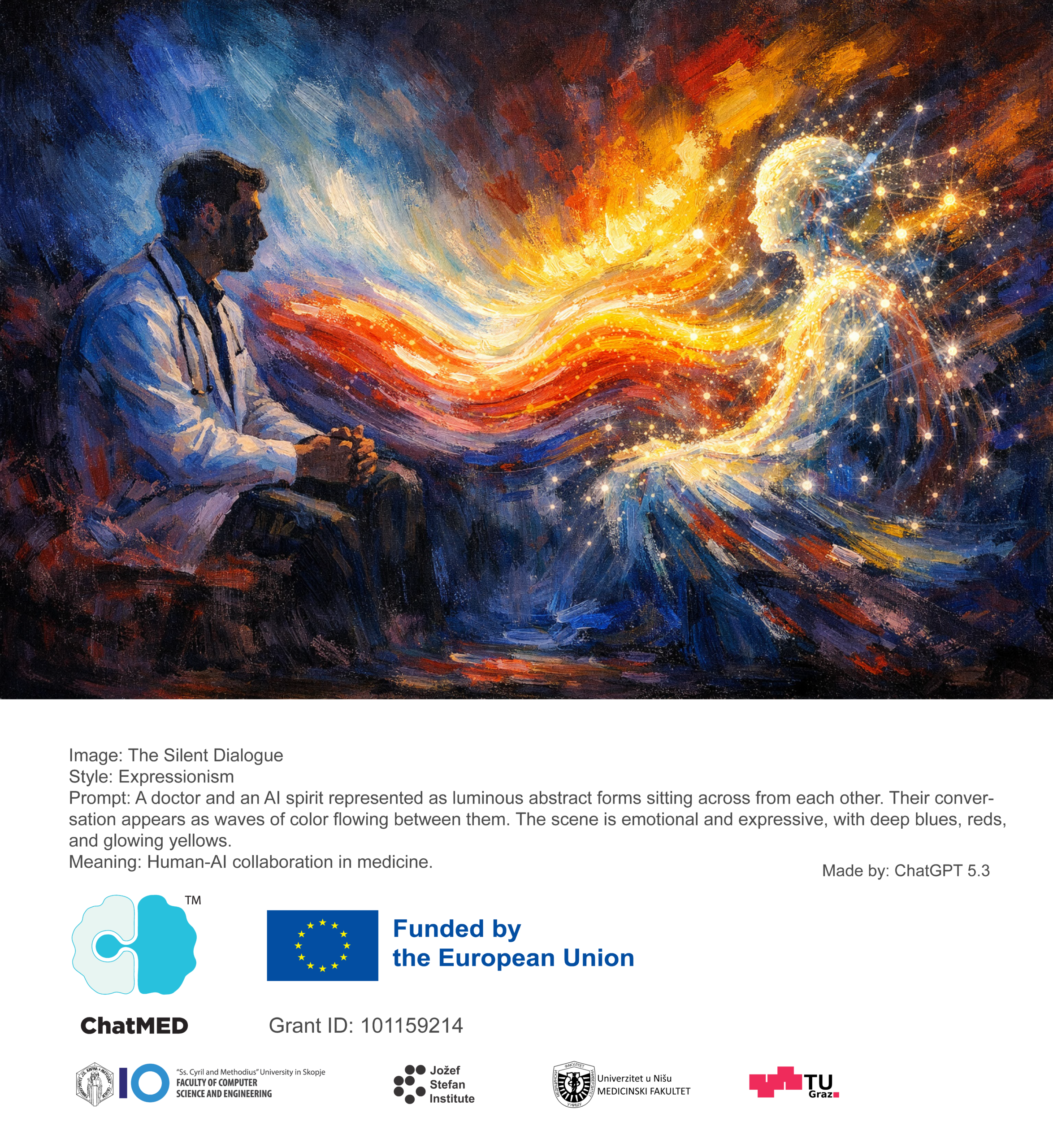
Visitors encountered constellations of knowledge, dreaming neural landscapes, silent dialogues between human and artificial intelligence, rivers of biomedical data, and libraries where knowledge evolved into living structures. Each artwork offered a different perspective on how intelligence is created, connected, and transformed.
In this way, art fulfilled one of the central objectives of the Summer School: creating common ground between different ways of thinking.
Translating Science into Experience
One of the recurring themes throughout the Summer School was the idea of translation.
Translating complex medical knowledge into actionable insights.
Translating AI capabilities into clinical value.
Translating scientific discoveries into societal impact.
The art exhibition added another layer to this process by translating scientific concepts into visual experiences.
For a moment, knowledge graphs became constellations. Neural networks became forests and rivers. Human–AI collaboration became a conversation of colors and forms. Scientific ideas that are usually expressed through papers, algorithms, and datasets became something that could be experienced rather than explained.
As participants moved between lectures, workshops, and discussions, the exhibition offered an opportunity to pause, reflect, and reconnect with the deeper questions behind technological progress.
Because sometimes, the first step toward understanding the future is simply standing still and looking at it from a different perspective.