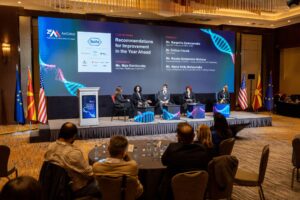
North Macedonia is entering an important new phase in its integration with European health initiatives. With the country becoming a member of the EU4Health programme, a national working group has recently been formed to help coordinate participation and maximize the opportunities offered by this major EU funding instrument.
Within this context, the ChatMED project is contributing directly to national capacity building. As part of the newly established working group, the ChatMED coordinator prepared a short training session designed to introduce the EU4Health programme and outline a practical roadmap for accessing its funding opportunities.
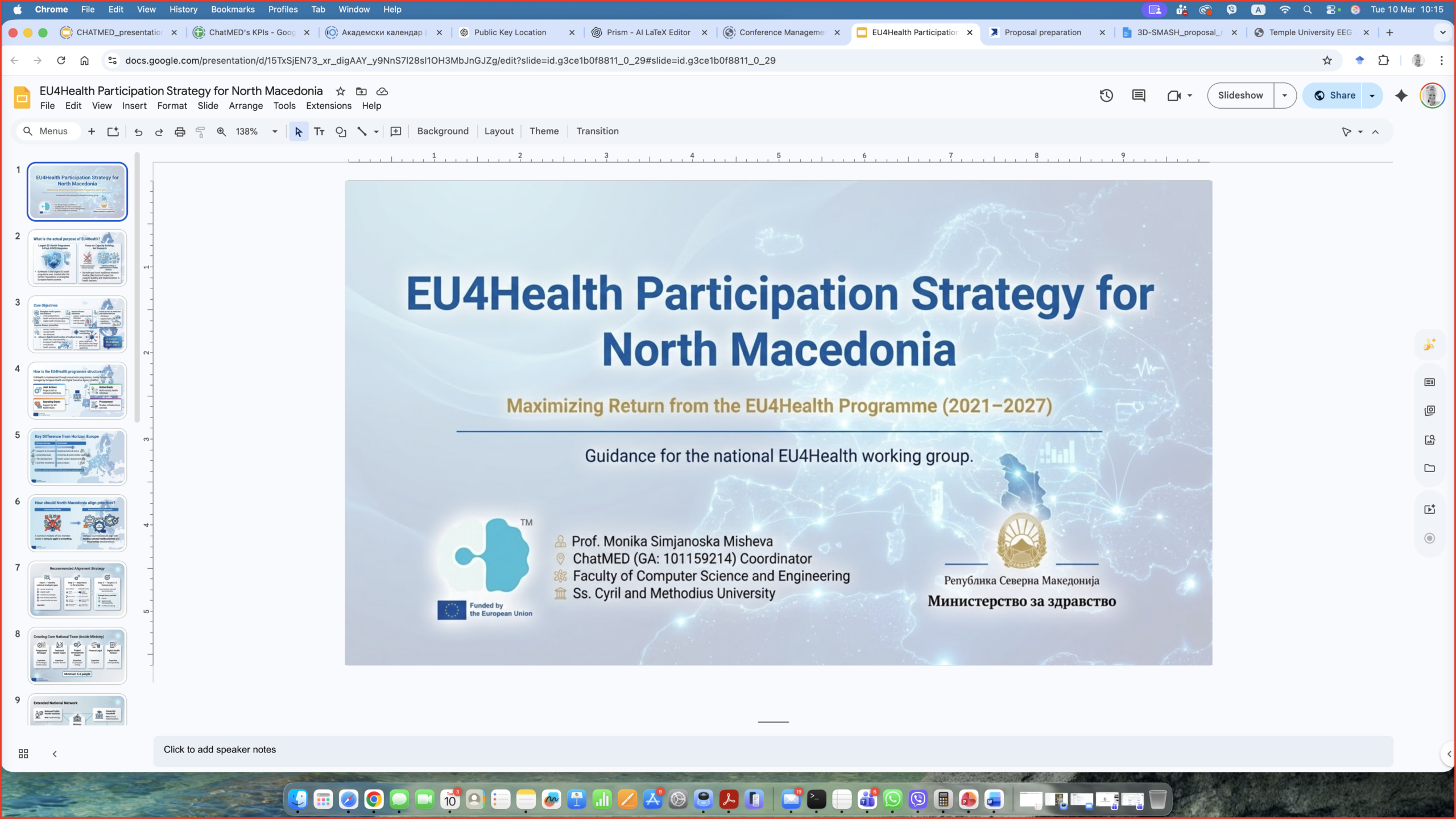
The session was inspired by the strategic presentation “EU4Health Participation Strategy for North Macedonia – Maximizing Return from the EU4Health Programme (2021–2027)”, which was developed as guidance material for the national working group.
Understanding the EU4Health Opportunity
EU4Health is the largest health programme ever launched by the European Union, created after the COVID-19 pandemic to strengthen health systems across Europe. With a budget of approximately €5.3 billion for the period 2021–2027, the programme focuses primarily on capacity building and implementation in health systems, rather than traditional research funding.
Its objectives include:
- strengthening the resilience of health systems
- improving disease prevention (including cancer, cardiovascular diseases, and mental health)
- ensuring access to medicines and medical devices
- advancing digital health infrastructure and interoperability
- improving EU-level coordination between national health authorities
For countries newly entering the programme, the challenge is not only understanding the funding calls, but also building the institutional structure and partnerships necessary to successfully participate in them.
From Research Projects to Health System Implementation
One of the key messages presented during the training is that EU4Health is fundamentally different from programmes such as Horizon Europe.
While Horizon Europe is primarily focused on research and innovation, EU4Health is designed for implementation, policy alignment, and strengthening health systems, typically led by ministries, public health institutions, and national authorities.
This means that successful participation requires:
- strong leadership from Ministries of Health or national public health authorities
- collaboration between public health institutes, hospitals, universities, and health IT providers
- alignment between national health priorities and EU policy priorities
Universities and research centers therefore play a critical role, but typically as partners rather than coordinators, supporting implementation and evidence generation.
A Roadmap for Successful Participation
During the session, a practical strategy was discussed for how countries can effectively engage with the programme.
A recommended approach includes three key steps:
- Identify national health system gaps. Examples include cancer screening programs, digital health infrastructure, workforce shortages, or disease registries.
- Map these needs to EU4Health priorities. For example linking national cancer initiatives with the Europe’s Beating Cancer Plan, or digital infrastructure with European Health Data Space objectives.
- Focus on a small number of strategic themes. Countries that succeed usually concentrate on two or three priority areas, rather than applying broadly across many topics.
This strategic focus allows national teams to build expertise, establish international partnerships, and progressively move from partner roles to coordinating projects.
Building the National Team
Another important topic discussed during the training was the institutional structure required to participate effectively in EU4Health.
A minimal national team should ideally include:
- a programme strategist familiar with EU health policies
- a technical health expert
- a project development expert experienced in EU proposals
- finance and legal expertise for EU grants
- a digital health and interoperability specialist
This core group should be complemented by a wider national network including:
- the Ministry of Health
- the National Public Health Institute
- university hospitals
- universities and research organizations
- health technology companies
Such collaboration ensures that projects address real health system needs while meeting EU programme requirements.
Learning from Countries with Strong EU4Health Participation
The training also examined how countries with successful participation – such as Slovenia, Austria, Italy, Spain, and the Netherlands – organize their national structures and partnerships.
These countries demonstrate that success typically depends on:
- a dedicated national proposal team
- strong international networks
- clear thematic focus
- consistent leadership from the Ministry of Health
Rather than creating only administrative committees, successful countries build stable coordination teams within their public health systems and actively participate in international consortia.
From Training to National Impact
The short training session organized through the ChatMED initiative represents an important first step toward building national expertise for participating in EU4Health. By sharing experience from EU-funded projects and international collaboration networks, the initiative helps bridge the gap between European funding opportunities and national implementation capacity.
However, building successful participation in EU programmes requires more than understanding the rules. It requires learning directly from countries that have already built strong national coordination mechanisms and repeatedly succeed in EU4Health calls.
For this reason, the next step will move from strategic orientation to practical capacity building. The working group plans to begin learning directly from experienced EU4Health actors, starting with Slovenia. A representative from the National Institute of Public Health of Slovenia (NIJZ), one of the most experienced institutions in coordinating EU4Health initiatives, will be invited to serve as a lecturer during the upcoming training mission in April 2026 at the Jožef Stefan Institute (JSI) in Ljubljana.
The event is expected to attract a strong delegation of representatives from the Ministry of Health of North Macedonia, together with experts from national health institutions, with the goal of understanding first-hand how successful EU4Health projects are structured, coordinated, and implemented.
Through initiatives such as this training session and the upcoming international training mission, the ChatMED project continues to contribute to strengthening the institutional readiness of North Macedonia for participation in European health programmes.
EU4Health is not only a funding instrument, it is an opportunity to modernize health systems, strengthen international collaboration, and accelerate the integration of national healthcare ecosystems into the European health landscape.