Drug discovery is not a single prediction problem.
It is a chain of decisions, from molecule design to clinical evaluation, where each step constrains the next. Yet most AI systems today still operate in silos, solving individual tasks without preserving continuity across the pipeline.
Prompt-to-Pill explores a different paradigm: treating drug development as an end-to-end workflow, orchestrated by specialized AI agents that collaborate across discovery, preclinical evaluation, and clinical simulation.
From Isolated Models to Coordinated Reasoning
Large Language Models and foundation models have already shown strong performance in molecule generation, docking, ADMET prediction, trial design, and patient matching. What has been missing is integration – a way to connect these capabilities into a coherent system that reflects how drug development actually unfolds.
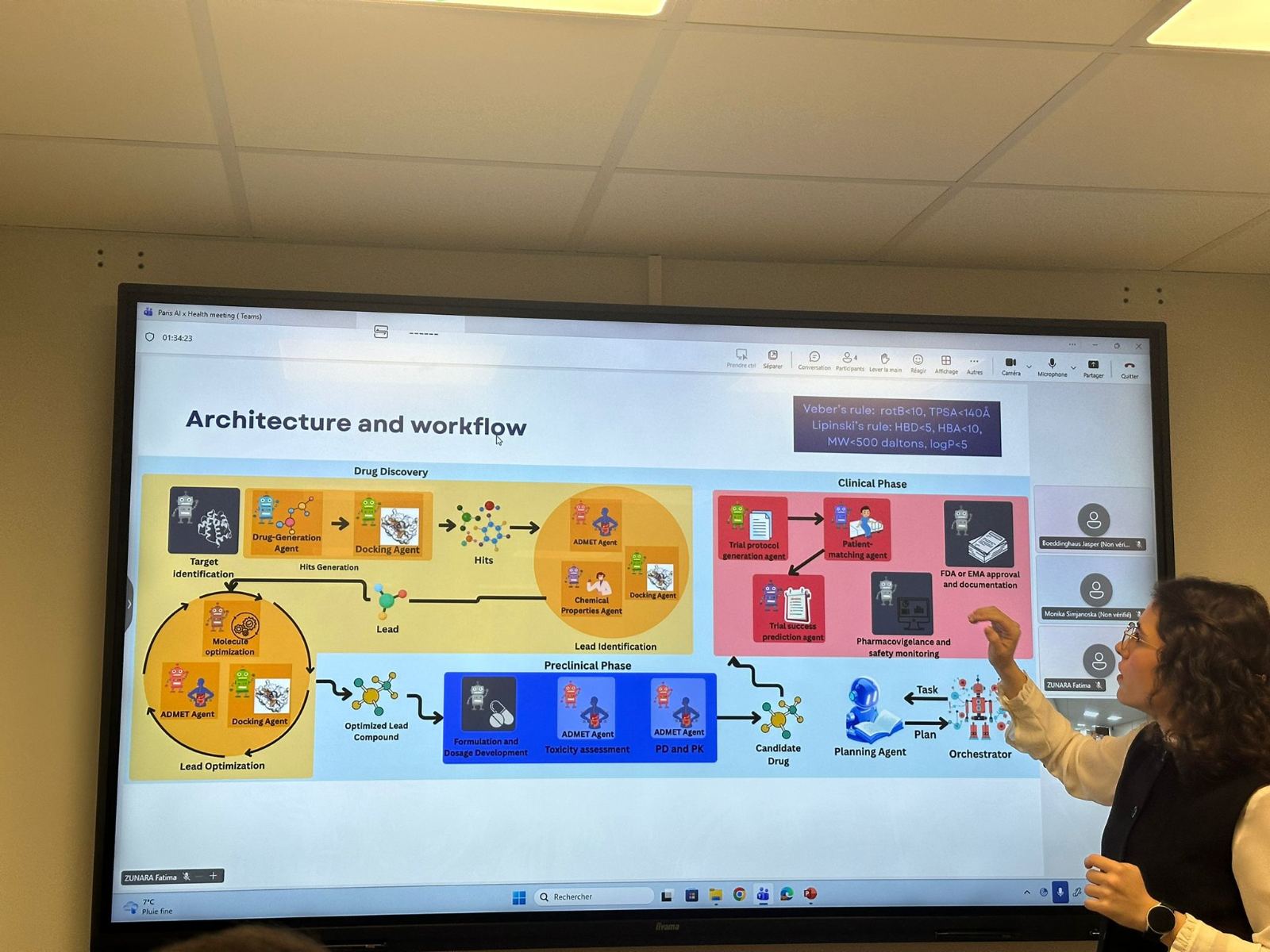
Prompt-to-Pill addresses this by organizing the pipeline into a multi-agent architecture, where each agent performs a well-defined role and passes structured outputs forward. A central Orchestrator coordinates task flow, maintains context, and ensures that decisions made early in the pipeline inform later stages.
A Three-Phase Agent Architecture
The Prompt-to-Pill framework is structured into three conceptual phases:
🔬 Drug Discovery
Agents generate candidate molecules, evaluate binding through docking, and filter compounds based on physicochemical and drug-likeness criteria. Promising leads are iteratively refined through optimization loops.
🧪 Preclinical Evaluation
Selected candidates undergo systematic ADMET and pharmacokinetic assessment, ensuring that downstream reasoning remains grounded in chemically and biologically plausible compounds.
🏥 Clinical Simulation
The pipeline then extends into trial design, patient eligibility screening using EHR-like data, and trial outcome prediction — reframing drug discovery as a hypothesis-driven process that explicitly considers clinical feasibility.
Together, these agents form a continuous workflow rather than a collection of disconnected tools.
Demonstrating the Concept
To demonstrate feasibility, Prompt-to-Pill was instantiated for a single, well-characterized target: DPP4. The use case illustrates how generated molecules can be carried forward through docking, optimization, and virtual clinical trial simulation within one coherent system.
The emphasis is not on proposing a new therapeutic, but on showing that existing AI models can be meaningfully composed into an end-to-end pipeline with transparent structure and traceable reasoning.
Why Prompt-to-Pill Matters
Prompt-to-Pill bridges a long-standing gap between molecule-centric AI and trial-centric AI. By connecting discovery and clinical simulation within a single framework, it enables questions that isolated models cannot address:
If a compound looks promising in silico, what kind of trial would it support — and who would it enroll?
This shift moves AI from task-level optimization toward pipeline-level reasoning.
Looking Forward
As AI systems become more capable, the next challenge is not building better models, but building better systems around them. Prompt-to-Pill offers a blueprint for how modular, agent-based architectures can support coherent reasoning across the entire drug development lifecycle.
From molecule generation to virtual trials, the future of AI-driven drug discovery lies not in isolated predictions, but in connected intelligence — from Prompt-to-Pill.
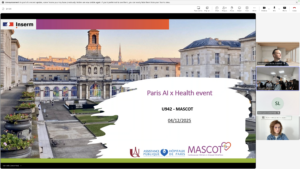
The whole paper is available in the Knowledge Repository and at https://doi.org/10.1093/bioadv/vbaf323. This work was also presented during the December 4th ChatMED networking meeting in Paris, hosted by AP-HP and Inserm, where it attracted strong interest from participating experts.