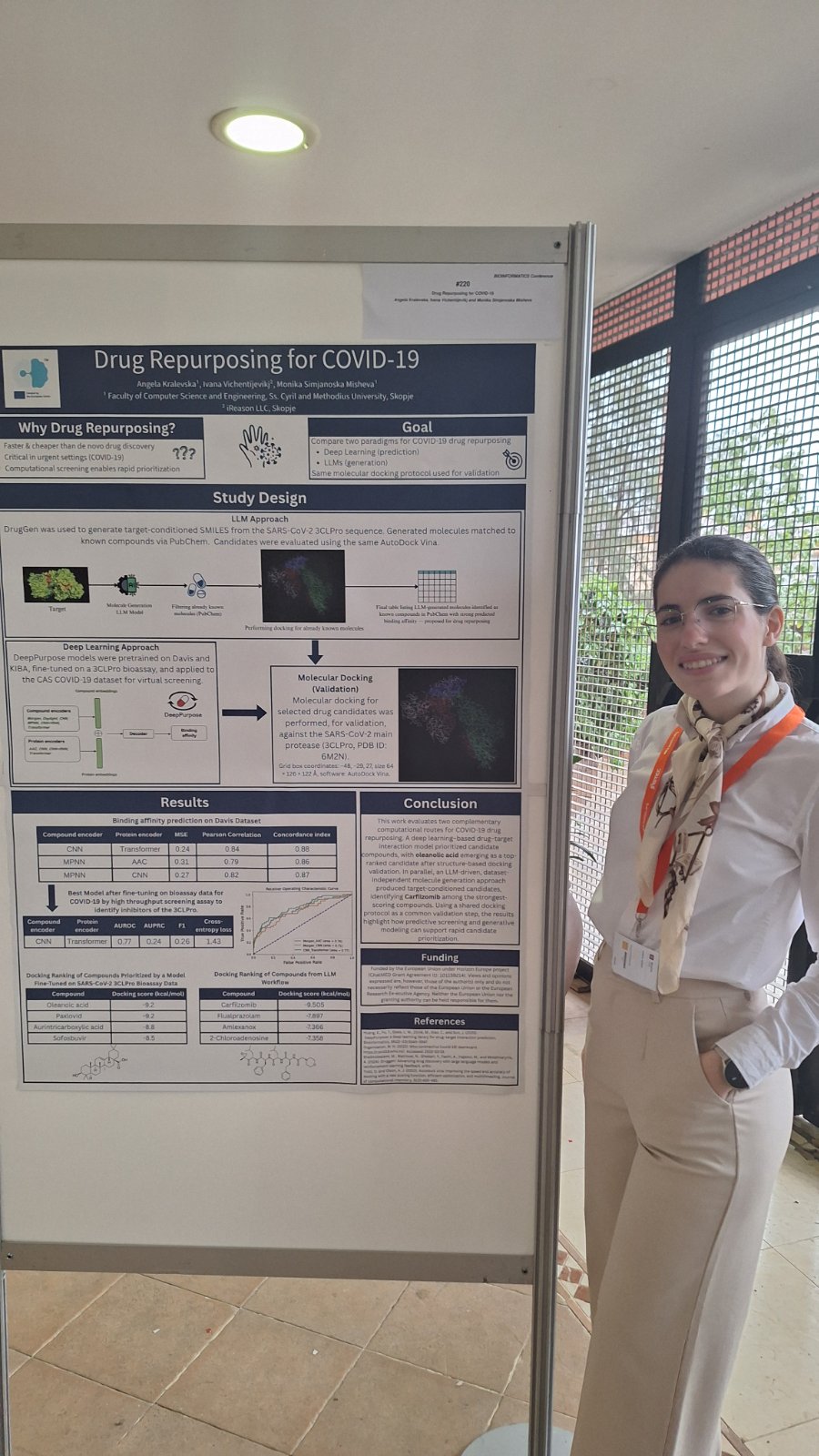
Another ChatMED research contribution was presented as a poster at the 17th International Conference on Bioinformatics Models, Methods and Algorithms (BIOINFORMATICS/BIOSTEC 2026) in Marbella, Spain.
The poster, entitled “Drug Repurposing for COVID-19,” presents a comparative study of two complementary computational approaches for identifying candidate drugs: a deep-learning-based drug–target interaction model and an LLM-driven molecular generation workflow. Both approaches were subsequently evaluated using a common molecular docking protocol against the SARS-CoV-2 main protease (3CLPro).
The work, authored by Angela Kralevska, Ivana Vichtentijevikj, and Monika Simjanoska Misheva, demonstrates how predictive and generative AI approaches can complement each other in computational drug repurposing. Among the candidates highlighted by the study, oleanolic acid ranked strongly in the deep-learning workflow, while Carfilzomib emerged among the strongest candidates generated through the LLM-based approach.
The poster contributes to ChatMED’s broader exploration of how AI, bioinformatics, and generative models can support biomedical discovery and decision-making.