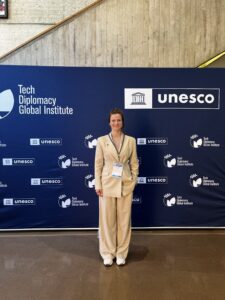
Following her recognition with the Most Disruptive Award at the first Women in Tech® Macedonia Awards, ChatMED coordinator Prof. Dr. Monika Simjanoska Misheva was nominated by the President of the Republic of North Macedonia, H.E. Prof. Dr. Gordana Siljanovska-Davkova, to represent the country in the inaugural Tech Diplomacy Global Executive Program (TDGEP) of the Tech Diplomacy Global Institute.
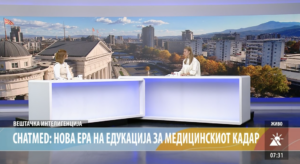
The nomination came shortly after the Women in Tech recognition, which highlighted Simjanoska Misheva’s work in connecting research, technology and real-world impact, including through the coordination of ChatMED. In an interview following her selection, she explained that the nomination came directly from the President after an invitation was received to nominate a North Macedonian participant for a fully funded place in the program.
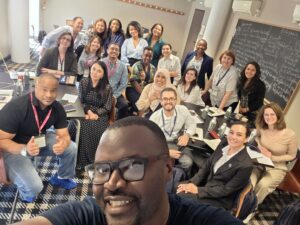
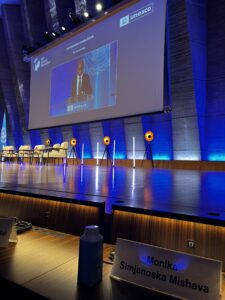
TDGEP brings together leaders working at the intersection of technology, diplomacy, public policy and digital sovereignty. Its inaugural cohort officially began in Paris on 29 June 2026, gathering 20 participants from 16 countries for the opening residential week of a six-month program running through December. The program combines executive education, international exchange and the development of national capstone projects addressing concrete government priorities.
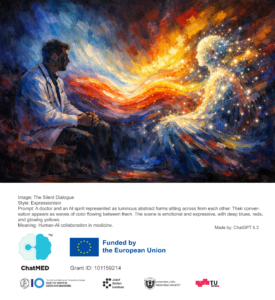
For ChatMED, the nomination also marks an important extension of the project’s broader mission. Moving advanced AI research in healthcare from scientific results toward practical adoption depends not only on technological performance, but on an ecosystem of institutions, regulation, data, infrastructure, professionals, trust, funding and coordination. This connection between technological innovation and the institutional environment required to adopt it is precisely where tech diplomacy becomes increasingly relevant.
Participation in TDGEP therefore provides an opportunity to connect the experience gained through ChatMED and European research with a broader discussion on how countries such as North Macedonia can strengthen their digital sovereignty, strategic autonomy and capacity to participate in shaping the governance of emerging technologies, rather than simply adapting to rules and technologies developed elsewhere.
The nomination represents another important recognition of the role that research and academia can play beyond scientific production — connecting technological expertise with national priorities and international cooperation.